We’ll start with a truth that many people in the industry don’t like to hear. Most immersive projects don’t fail because of the wrong headset or technology. They fail because nobody agrees on what successful performance actually looks like before development begins.
When operations, training, and safety teams define competence differently, projects default to focusing on appearance instead of outcomes. The result is often a polished simulation that teaches the wrong behaviours. As virtual worlds become cheaper to build, the real value is shifting from technology to judgement, yet many organisations are still investing the other way around. Here’s why that needs to change.
The Platform War Ended Without a Winner
For years, immersive projects started with a platform decision. Build for Meta or build for HTC and commit to the ecosystem. Today, that choice matters far less than it once did.
Meta may have held nearly 75% of the global AR and VR headset market in 2024, but recent shifts have shown how fragile platform-led strategies can be. Apple’s Vision Pro saw sales drop sharply after launch, while Google and Samsung moved toward Android XR, creating a more open ecosystem that invites new hardware players into the market. As a result, emerging VR platforms are increasingly being built around open standards rather than closed environments.
That’s the real story. Technologies like OpenXR now allow developers to build once and deploy across Quest, Android XR devices, and PC VR, making cross-platform delivery a practical reality rather than a marketing promise. The headset is no longer the centre of gravity. Flexibility is.
It’s a lesson we’ve followed for years. Many of our mining and infrastructure clients needed the same experience to work across HoloLens, mobile devices, and VR headsets. What once felt like a technical constraint turned out to be the smartest long-term strategy.
The Headset Stopped being the Centre of Gravity
Now the number that should genuinely rearrange your roadmap.
IDC reported that mixed and virtual reality headset shipments were set to fall 42.8% in 2025, while the rest of the XR market grew 211.2%. Read that twice. The category everyone calls VR contracted hard, and the wider market boomed anyway, because glasses carried it.
The momentum kept building. IDC recorded smart glasses surging 167% year over year in the first quarter of 2026, with display-less glasses shipping roughly as many units in that single quarter as the entire category managed across all of 2024. Meta earned more from glasses than from Quest hardware. Average selling prices sit near $376 and keep compressing.
What does this mean for the greater VR headset market? From where we sit today, it looks as though the average consumer cares about 2 main selling points.
Normal-looking glasses have centuries of social norms on their side. We’re completely used to seeing people wear them. What we aren’t used to is someone walking down the street with a VR headset strapped to their face. We’re still a few years away from that feeling normal.
Buying a nice pair of sunglasses for a few hundred dollars is already a normal purchase for many people. Adding smart features just feels like a premium upgrade to an everyday item. But dropping $500 or more on a VR headset feels like a massive financial leap for a device you can really only use sitting at home.
So the evolution of virtual reality isn’t a story about better headsets. It’s a story about immersion splitting into two different jobs.
A 45 minute seated simulation and a three second overlay on a pair of glasses share a technology stack and almost nothing else. One is a place your people go to practise. The other rides along while they work, hands free, feeding them the next step at the moment it matters.
Design for one and you’ve solved half your problem.
Building the World Used to be the Expensive Part. It isn’t Anymore.
For years, the biggest cost in immersive projects was creating the environment itself. If you wanted a realistic training site, facility, or operational scenario, you needed significant time, specialist talent, and budget to build it from scratch. That’s no longer the case.
Two major shifts have changed the economics of immersive development:
Capture Became Dramatically Cheaper
Technologies such as Gaussian splatting can reconstruct photorealistic environments from standard video footage, turning real-world locations into immersive, walkable digital spaces in a fraction of the time traditional 3D modelling once required.
AI-powered Generation Became Practical
Modern AI tools can now be used to help artists and designers rapidly create photorealistic 3D assets. Platforms such as Android XR are going even further by integrating AI capabilities that can transform images and videos into 3D content directly within the ecosystem.
Together, these shifts have completely inverted the old cost structure. The task that once consumed the majority of a project’s budget, building a believable virtual world, is no longer the primary challenge. Creating realistic environments is becoming increasingly commoditised.
While that should be good news, it has created a new problem. Many organisations still evaluate next-generation VR technology based on visual fidelity because, historically, realism was a reliable indicator of effort and investment. Today, that’s no longer true. High-quality visuals are easier to achieve than ever, which means realism alone tells you very little about the value of the experience.
If a studio still pitches you primarily on how photoreal their renders are, they’re selling last decade’s advantage at this decade’s prices. We unpacked more of this shift in our piece on how AI and immersive learning are transforming workforce training.
Foveated Streaming could Change Where VR Gets Rendered
One of the more interesting developments in immersive technology is foveated streaming.
To understand why it matters, start with a simple problem.
High-quality VR requires a lot of computing power. Detailed 3D environments, realistic lighting, high-resolution textures and smooth frame rates all demand significant processing.
Traditionally, much of this work happens on the headset itself.
But what if the heavy computing could happen somewhere else?
That is the idea behind foveated streaming.
Instead of requiring the headset to render everything locally, powerful content can be rendered on a PC or cloud system and streamed to the headset. Eye tracking can then be used to prioritise the highest visual quality around the area where the user is looking.
The result is a more efficient way of delivering highly detailed immersive content.
Apple’s Foveated Streaming technology for visionOS 26.4 is a current example of this direction. It allows high-fidelity immersive content to be streamed from local or cloud endpoints to Apple Vision Pro, with support for OpenXR content and NVIDIA CloudXR. Apple also highlights applications such as CAD, 3D modelling, scientific visualisation and simulation.
This could become particularly useful for experiences that are too demanding to run comfortably as standalone applications.
Think about an engineering model containing millions of detailed components.
Or a training simulation recreating a large industrial environment.
Or a visualisation application that needs complex calculations and high-resolution assets.
Rather than putting all of that processing responsibility on the headset, some of the workload can move to more powerful computing infrastructure.
For businesses, that creates another question when planning a VR project:
Does everything need to run on the device?
Increasingly, the answer may be no.
Cross-platform VR Development is Becoming More Important
There is another change happening behind the scenes.
Businesses rarely want to invest heavily in content that only works on one device.
The hardware market continues to change. New headsets, mixed reality devices, smart glasses and other spatial computing products are entering the market.
That makes portability increasingly important.
OpenXR is playing a significant role here by providing a standard way for developers to build immersive applications across different XR platforms. Its ongoing development around spatial capabilities is intended to make it easier to create portable spatial experiences rather than building completely separate implementations for every device.
For businesses commissioning VR content, this has a practical implication.
A project should not only answer:
What headset are we using today?
It should also consider:
Where might this experience need to work tomorrow?
That could influence decisions around the development engine, interaction design, content formats and technical architecture from the beginning.
Planning for platform flexibility can make it easier to adapt an experience as the hardware landscape changes.
VR is Becoming More Connected to the Physical World
One of the most interesting developments in immersive technology is that the goal is not always to make the physical world disappear.
Sometimes the goal is to make digital information more useful within it.
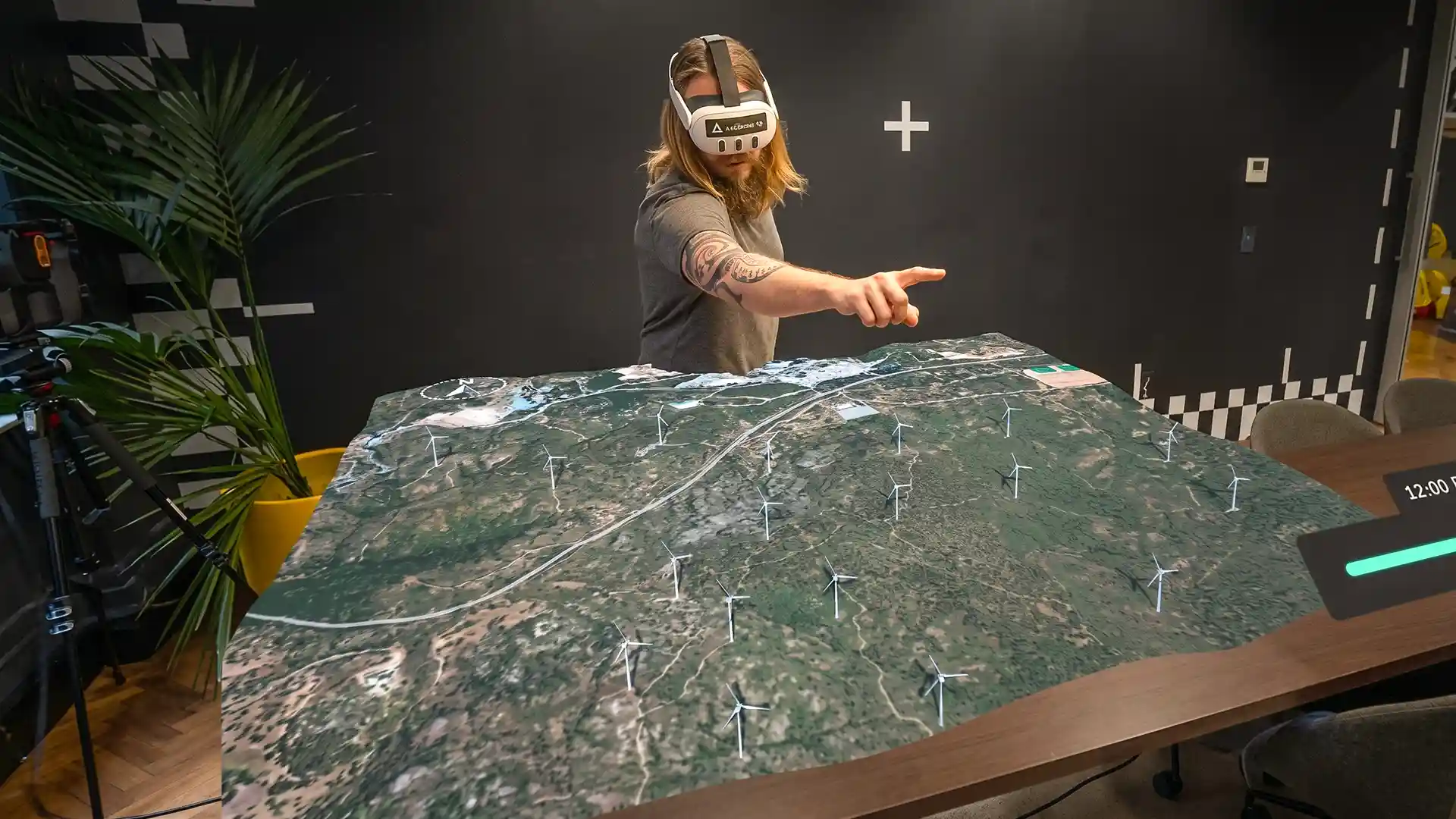
Imagine an engineer looking at a physical machine and seeing a digital model aligned with it.
A trainee could see virtual guidance while working through a real procedure.
An architect could walk around a life-sized digital representation of a proposed space.
A maintenance worker could access spatial instructions while standing in front of the equipment they need to work on.
These experiences combine physical space with digital information.
That is where VR, AR and mixed reality start to overlap.
Apple’s current spatial computing tools demonstrate this direction too. Streamed immersive content can be combined with native capabilities such as RealityKit and ARKit, allowing digital content and physical surroundings to work together in the same experience.
For businesses, this could be more valuable than simply creating a visually impressive virtual environment.
The real benefit may come from putting the right information in the right place at the right time.
The Way VR Content is Created is Changing Too
It is easy to focus on what users see inside a headset.
But the production process behind immersive content is changing just as quickly.
Developers and content teams now have access to tools for AI-assisted asset creation, real-time 3D development, photogrammetry, 360 video, virtual production and increasingly sophisticated simulation environments.
This is making it possible to create and update immersive content in different ways.
A business might capture a real environment using 360 video.
Another might build a completely interactive 3D simulation.
A third might combine real-world footage with computer-generated elements.
There is no single format that works for every objective.
That is important because immersive content should start with the problem, not the technology.
A safety induction may benefit from 360 video because it puts employees inside a real workplace.
A complex engineering application may need interactive 3D.
A product demonstration could benefit from augmented reality.
A soft-skills programme might need AI-driven characters and conversation.
The technology should follow the experience you are trying to create.
What does this Mean for Businesses Investing in VR?
The changing VR landscape creates more opportunities, but it also makes technology decisions more complicated.
Businesses need to look beyond headset specifications.
Before starting an immersive project, it is worth asking:
- What problem are we trying to solve?
- Who will use the experience?
- Where will they use it?
- Does the content need to interact with the physical environment?
- Which devices need to support it?
- Does the experience need to scale across multiple locations?
- Will the content need regular updates?
- Should processing happen locally, remotely or through the cloud?
These questions can influence everything from the content format to the development platform.
For a training project, for example, the most important measure may not be how realistic the environment looks. It may be whether employees remember the procedure and perform it correctly afterwards.
For an engineering project, the priority may be whether teams can understand a complex design before anything is built.
For a safety simulation, the value may come from allowing people to practise a dangerous situation without being exposed to the real-world consequences.
That is where immersive technology becomes more than a demonstration.
It becomes a business tool.
What this Looks Like from Australia
The market backs the direction. Australia’s AR and VR sector should grow from roughly $1.2 billion in 2026 to $2.75 billion by 2031, a compound annual growth rate near 14.8%.
But the driver matters more than the number. Analysts now attribute enterprise adoption to structural pressure rather than innovation budgets. Labour shortages. Rising training costs. Tighter safety and compliance obligations. Crews spread across remote sites. That list describes Australian mining, healthcare, construction and vocational training almost exactly.
Which brings us to the local gap. It isn’t appetite, and it isn’t budget. Industry analysis repeatedly flags a shortage of locally developed XR content, and we’d sharpen that further. The shortage isn’t of Australian looking environments. It’s of content built by people who have stood on the site, argued with the safety lead, and understood why the procedure reads the way it does.
You can generate a Pilbara environment with AI this afternoon. You cannot generate the reason an experienced operator hesitates at a particular step.
Wrapping Up
Hardware cycles run about eighteen months. Your content strategy needs to run a decade.
The organisations that win the future of VR platforms won’t be the ones with the best headsets. They’ll be the ones that did the unglamorous work first, wrote down what good actually looks like, built honest failure into the experience, and measured something their board already cares about.
The technology stopped being the hard part. That’s the opportunity, and it’s also the uncomfortable bit, because it means the quality of your immersive programme now depends almost entirely on the quality of your thinking before anyone opens Unity.
Planning your first immersive project, or your next one? Talk to the Viewport XR team. Fair warning: we’ll start by asking what competent looks like.