For years, virtual reality focused on one question: what can people see, hear, and do inside a digital world? Eye tracking in VR introduces a more important question: what did they actually notice?
This shift has major implications. Modern VR headsets track gaze in real time, capturing where users look, how long they focus on specific objects, and what they ignore. More importantly, eye-tracking data does far more than enhance immersion. It helps organisations understand how people behave, make decisions, and respond to critical situations in realistic environments.
At Viewport XR, we design immersive VR experiences for industries including mining, healthcare, construction, and education. That practical experience shapes how we view eye-tracking technology. We focus on its real-world impact, not the hype. The future of virtual reality goes beyond placing people inside digital environments. It lies in creating intelligent environments that adapt, respond, and improve based on how people interact with them.
What VR Eye Tracking Is, and How It Works
VR eye-tracking technology operates directly inside the headset. Small infrared cameras illuminate the eyes, while built-in sensors capture the reflections and track pupil movement dozens of times per second. The system then analyses this data stream to determine exactly where users look and how their eyes respond in real time.
From this continuous flow of data, the technology extracts several key signals:

Gaze direction
Where the eyes are aimed right now.

Fixations
The moments the eyes settle and hold.

Saccades
The fast jumps between one point and the next.

Pupil and blink patterns
Shifts that can hint at effort or fatigue.
Why Eye Tracking Changes the Experience
Three shifts sit underneath the benefits of eye tracking in VR.
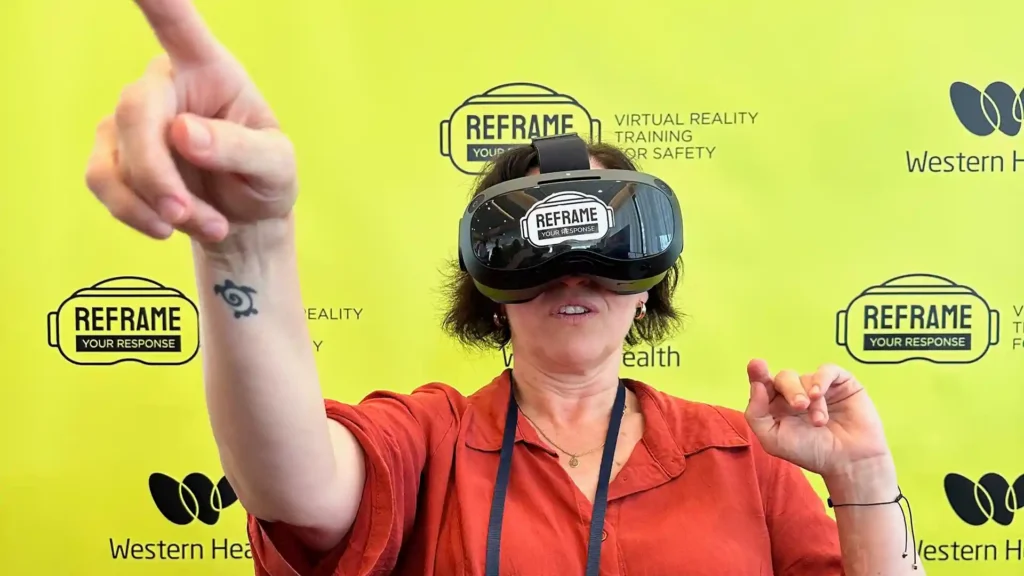
Interaction gets simpler
Gaze detection can lock interactions to the object being looked at, eliminating accidential miss-clicks or unintentional interactions.

Analytics and Testing
Correlating the data at the end of a VR testing session is a great way to see where trainees struggled and where they excelled. Eye tracking adds to this data by highlighting key points that the user’s attention was drawn to.
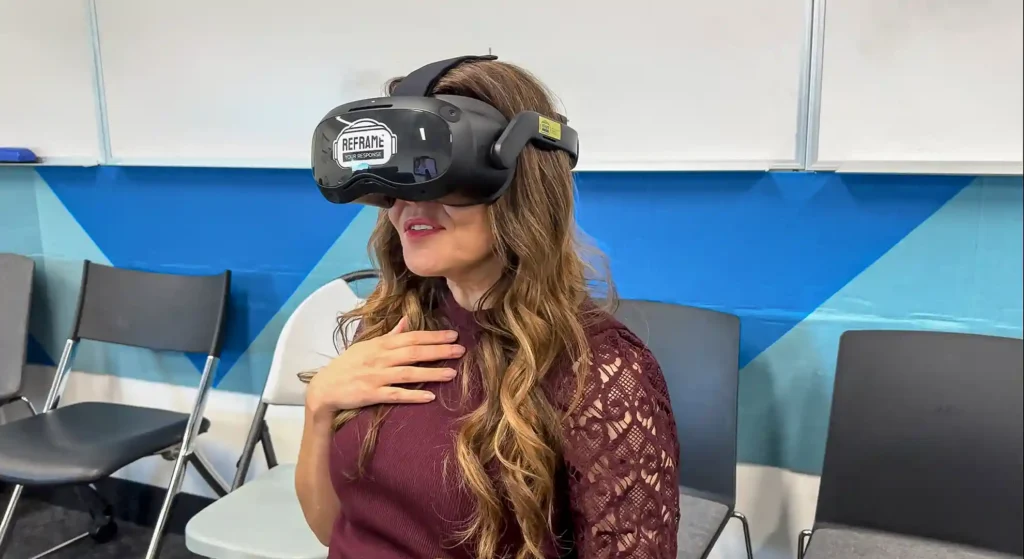
A Smoother Experience
Modern VR headsets like the Apple Vision Pro render the area that the user is looking at in full resolution while rendering the surrounding areas in lower resolution. This rendering technique is called “foveated” rendering and it helps the experience to run much smoother than older headsets.
What Organisations Can Actually Do with Gaze Data
This is where the technology earns its keep between a demo and a defensible result.
Take safety training as an example. Before eye tracking, a trainee could pass a VR assessment simply by completing the correct steps in the right sequence. Trainers could assume the trainee noticed an exposed edge, warning sign, or emergency shut-off valve, but they had no way to verify it.
Eye tracking changes that. The same training session can now show exactly where the trainee looked, how long they focused on key hazards, and whether they noticed critical safety information at all. Instead of saying, “They passed the assessment,” organisations can say, “They saw the hazard, responded to it, and we have the data to prove it.”
For a VR training company working in high-risk industries, that distinction matters. Eye-tracking data transforms training from a simple completion exercise into a measurable, auditable process. It provides clear evidence of attention, awareness, and decision-making, helping organisations move beyond demonstrations and deliver defensible training outcomes.
Design teams gain a similar edge. Gaze data shows which parts of an interface pull attention and which get missed, so important information stops hiding in plain sight.
Product and consumer research gets its own lift. Inside a controlled virtual store, a brand can watch how shoppers scan a shelf, a pack, or a price. It reads what actually catches the eye, without the cost of building the store.
Healthcare, research, and education round out the list, where measuring attention beats simply describing an experience.
Foveated Rendering
Eye tracking doesn’t just reveal what people notice in VR. It also changes how VR performs. It’s called foveated rendering.
The headset draws full detail only where you look, and eases off in the corners your eye can’t resolve anyway. The payoff is real. On some systems, foveated rendering cuts the graphics workload by up to 72 percent. Meta reports developers pushing 77 percent more pixels into the centre of view once they switch it on. Headsets like the Varjo XR-4 now render 14 million pixels per eye, a number that only works because eye tracking spends the power where it counts.
For enterprise work, that headroom is a B2B power tool. It means sharper training scenes, longer sessions, and lighter hardware. As more Australian operations move toward a digital-first strategy, performance and scale stop being nice-to-haves.
Where It Matters Most

In mining
gaze data can show whether a worker clocks a hazard or follows the visual cue in a simulated pit.

In construction
It can flag where a trainee’s focus goes during a high-risk task, before that task moves to a real site.

Healthcare
Uses it for training and for studying attention under pressure.

Defence and emergency teams
Use it to see how people direct their focus when the clock is against them. Field and industrial crews stand to gain hands-free, gaze-aware instructions on the job.
Frankly, none of this is about entertainment. The strongest use of eye tracking in virtual reality is helping organisations understand how people behave when the cost of missing something runs high. That’s the ground Viewport XR knows, and it’s central to virtual reality Australia at the enterprise level.
The Problem With “They Looked at It”
It wasn’t easy to learn this next part, and it’s worth saying plainly. Looking is not seeing. Seeing is not understanding. Understanding is not remembering.
Gaze data can be noisy. Calibration drifts. Headset fit changes the read. Glasses, eye shape, age, and neurological differences all shape how a person’s eyes move. Pupil size can widen from effort or from bright light, so reading it as pure emotion is a trap.
That’s why we never treat a single glance as proof. Real insight comes from stacking signals: gaze plus task performance, time to complete, actions taken, and what the person says afterward. Eye tracking is a strong witness. It shouldn’t be the only one in the room.
Privacy, Consent, and the Ethics of Gaze Data
Gaze data is not ordinary analytics. It can hint at attention, habit, effort, and state of mind. That power raises fair questions. Who owns the data? How long is it kept? Was the person told, and did they agree? Is it used only for the stated purpose, or could it quietly profile someone?
Good XR builds answers to those questions from day one, not after a complaint lands. The question was never whether we can collect more from immersive experiences. It’s whether we should, and how we handle it once we do. Get that right and trust follows. Workers lean in, and leaders sign off. Get it wrong, and no amount of sharp graphics wins that trust back.
Where VR Eye Tracking Is Heading
The next stretch is about convergence.
Eye tracking and AI will read patterns at scale and shape training that adapts to each learner. Gaze will work alongside hand tracking, voice, and spatial mapping, so control feels natural. Paired with digital twins, gaze behaviour can play out against an accurate model of a real site. The same shift moves past the VR headset into augmented reality, where a gaze-aware overlay can guide a technician through a repair, hands free.
The direction is steady. Immersive technology is moving from fixed experiences to systems that respond.
The Future of VR Is Not Just More Immersive. It’s More Intelligent.
Eye tracking changes how people act inside VR. It opens new ways to see behaviour, sharpen training, guide design, and lift performance. If you read carelessly, it misleads but if you read it well, with consent and context, it turns immersion into evidence.
The organisations that win with immersive technology won’t be the ones with the flashiest headsets. They’ll be the ones who know what the technology is for, what people are truly doing inside it, and how to turn that into real-world results.
That’s the work we do at Viewport XR, from Perth to the world. If you’re weighing VR training solutions, or want to see what gaze-aware, immersive VR experiences could do for your team, let’s talk.