




VR Mine Safety Training

Reducing Underground Hazards

Virtual Reality (VR) mine safety training uses immersive digital environments to simulate real-world mining conditions and hazards. This technology helps prepare personnel for high-risk underground scenarios without physical danger. It bridges the gap between theoretical knowledge and practical, intuitive responses, an increasingly important factor as regulatory landscapes evolve and demand greater competency in risk management for statutory supervisors.

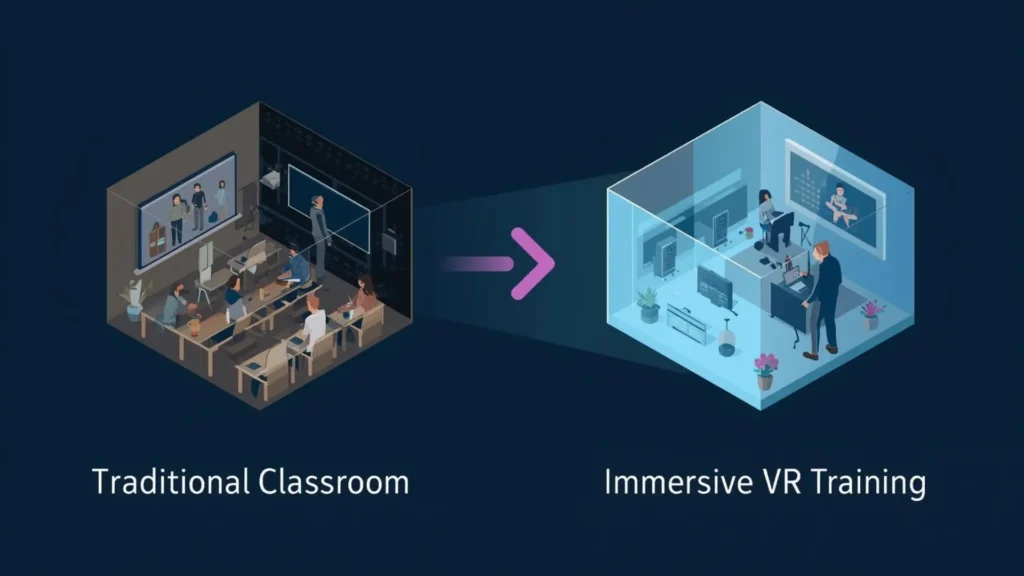
Traditional training often relies on classroom presentations. While informative, this approach can struggle with knowledge retention, especially for new personnel entering complex underground environments. VR offers a solution by creating vivid experiences that foster a deeper understanding of potential dangers and appropriate safety protocols.

How VR Builds Hazard Intuition

VR training engages the brain’s emotional centers, particularly the amygdala, to create powerful, memorable learning experiences. When trainees encounter a simulated near-miss, such as a virtual rockfall or gas leak, their brains process the danger emotionally without actual physical harm. This process helps form strong memories of hazards, influencing future responses in real situations. Research indicates that virtual reality can facilitate the creation of fear memories in a controlled environment, which can then be used to develop appropriate avoidance behaviors or responses. [1]

This immersive approach develops a critical “hazard intuition.” Personnel learn to recognize subtle cues and react instinctively, moving beyond simply knowing safety rules to reflexively acting on them. This intuitive response is vital for preventing incidents in fast-paced, high-stakes environments.

Diagram showing transition from traditional classroom training to immersive VR training

Developing High-Fidelity Muscle Memory

Specific underground tasks, like scaling loose rock, bolting supports, or operating heavy equipment such as Load-Haul-Dump (LHD) loaders, require precise movements and reactions. VR allows personnel to perform these tasks repeatedly in a zero-risk setting. This repetitive practice builds high-fidelity muscle memory.

Repeated exposure in a virtual environment helps embed the correct procedures and responses into long-term memory. This means that when facing a real-world scenario, the trained responses are more likely to be automatic and efficient, reducing hesitation and potential errors. Studies show VR is effective in motor skill acquisition and rehabilitation, demonstrating its capacity to build practical competency. [2]

Enabling Data-Driven Competency Assessment

Beyond traditional pass/fail assessments, VR platforms can provide detailed, objective data on trainee performance. This includes biometric feedback that tracks how a trainee interacts with the virtual environment.

Key metrics often include:

Gaze Tracking

Did the trainee identify critical hazards like a crack in the roof or an unstable wall? Eye-tracking technology reveals where attention was focused. [3]

Interaction Patterns

Were safety procedures followed in the correct sequence? Did the trainee use the right tools or communication protocols?

Heart Rate Monitoring

In some advanced systems, physiological responses like heart rate can indicate stress levels, helping to assess a trainee’s ability to maintain protocol under pressure. [4]

Decision-Making Speed

How quickly did the trainee react to an evolving hazard?

This data moves competency assessment beyond subjective observation. It provides tangible evidence of skill mastery and hazard recognition, ensuring personnel are truly prepared for their roles.

What to Look For in VR Mine Safety Solutions

When considering VR for mine safety training, certain features enhance effectiveness and practicality:

Multi-User Support

The ability for multiple team members to train together in the same virtual space is crucial for practicing team-based emergency response or muster drills.

Real-Time Analytics

Solutions that offer immediate feedback and detailed performance reports allow instructors to identify areas for improvement instantly. Heat-maps of gaze patterns are particularly valuable for hazard recognition training.

Hardware Durability

Given the demanding nature of mining operations, VR hardware should be robust and designed for industrial use. Standalone headsets are often preferred for their portability and ease of deployment on-site.

Customizable Scenarios

The ability to adapt training scenarios to specific site conditions and unique hazards ensures relevance and maximizes training impact.

Scalability

The solution should be able to support a growing number of trainees and expand with evolving training needs.

Key Takeaways

  • VR mine safety training uses immersive simulations to prepare personnel for high-risk underground environments.
  • It builds “hazard intuition” by engaging emotional centers, creating memorable experiences without physical risk.
  • VR enables the development of high-fidelity muscle memory through repetitive, risk-free practice of critical tasks.
  • Advanced VR systems provide data-driven competency assessments, tracking metrics like gaze, interactions, and physiological responses.
  • When evaluating VR solutions, prioritize multi-user support, real-time analytics, and durable, site-ready hardware.

References

  1. Maples-Keller, J. L., et al. (2017). The use of virtual reality to facilitate fear extinction: A review of the current literature. Behavior Therapy, 48(4), 481-497. https://www.ncbi.nlm.nih.gov/pmc/articles/PMC5568853/
  2. Kim, W. S., et al. (2018). The effect of virtual reality-based training on motor function recovery in patients with stroke: A systematic review and meta-analysis. Journal of NeuroEngineering and Rehabilitation, 15(1), 1-10. https://www.ncbi.nlm.nih.gov/pmc/articles/PMC6036746/
  3. Bozgeyikli, E., et al. (2019). Gaze tracking in virtual reality: A survey. Virtual Reality, 23(4), 405-422. https://link.springer.com/article/10.1007/s10055-018-0346-4
  4. Parnandi, A., et al. (2019). Physiological sensing in virtual reality. IEEE Transactions on Visualization and Computer Graphics, 25(5), 2095-2104. https://ieeexplore.ieee.org/document/8691515

Testimonials

X
Privacy Overview

This website uses cookies so that we can provide you with the best user experience possible. Cookie information is stored in your browser and performs functions such as recognising you when you return to our website and helping our team to understand which sections of the website you find most interesting and useful.