How OzGrind Turned a Static Showroom into a VR “B2B Power Tool” for Polished Concrete Sales

When OzGrind needed a way to show clients exactly how a polished concrete floor would look before a single pour, Viewport XR built a VR showroom that now drives higher‑value deals and keeps architects coming back.

The Client

OzGrind is a polished concrete specialist working across residential, commercial, and industrial projects in Brisbane, the Gold Coast, and beyond. Their team fields constant questions from homeowners, architects, and corporate clients who all want the same thing: certainty about how a finished floor will look across an entire space, not just on a sample the size of your hand.​

In 2017, OzGrind set a clear goal. They wanted a virtual reality showroom that could display every major mix and finish at full scale, help secure higher-value architectural and corporate work, and reinforce their claim as the leader in polished concrete options in Australia. They also wanted a tangible point of difference, something they could put in front of prospects as the world’s first virtual polished concrete showroom and make it a central part of their sales story.

The Challenge

A Material You Can’t Picture at Scale

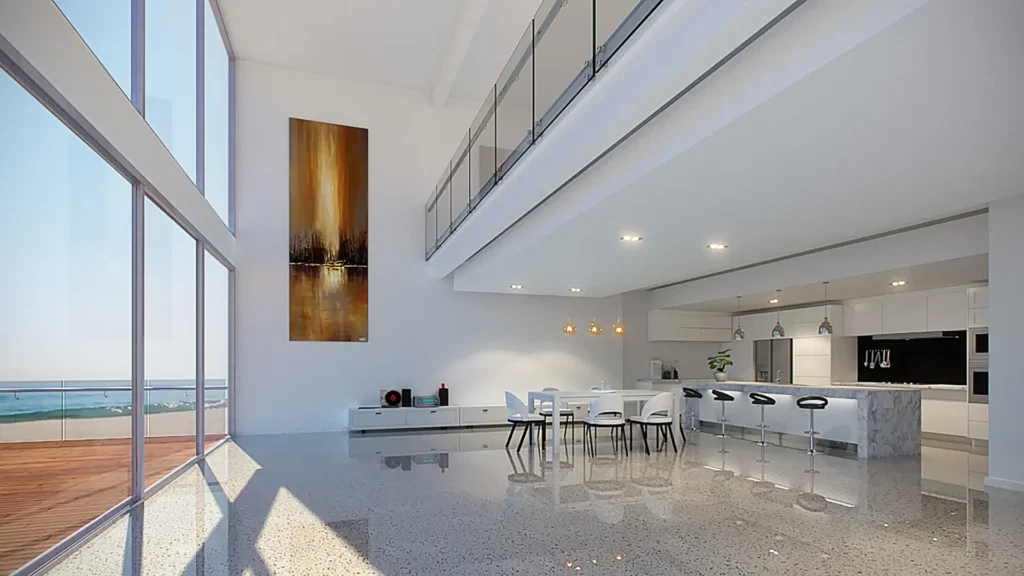
Before VR, OzGrind relied on physical sample boards, photos, and verbal explanations to guide clients through choices like exposure level, gloss, and aggregate size. A small tile under fixed showroom lighting only told part of the story. Spread that same mix across 200 square metres under a mix of natural daylight and artificial light, and it often looked and felt different.

The thing is, this gap between the sample and the final slab created friction at every step. Sales conversations took longer, because clients couldn’t quite picture the result. Architects hesitated to lock in specifications. Project owners worried about making a costly, permanent decision based on a tile they could hold in one hand.

There was also a precision problem. OzGrind works with premium suppliers like Hanson, Boral, and Holcim. If a Hanson mix used 10 mm aggregate, the VR representation had to show 10 mm aggregate, not “close enough.” If Boral’s Waterfall with a honed finish had a particular circular scratch pattern, the digital version had to show the same pattern when someone crouched down in the headset.

Early tests with procedural textures made the gap clear. Mathematical generation could scatter stones and simulate patterns, but it never truly matched the feel of the real Hanson, Boral, and Holcim mixes OzGrind sold every day. It looked neat, but not trustworthy. In this context, “almost right” would create doubt, not confidence.

So the core challenge was simple to state but hard to deliver:

  • let clients walk through a polished concrete choice with the same confidence they’d have if the floor already existed, and
  • meet a level of material accuracy that suppliers and architects could treat as a reliable reference, not a rough mock‑up.

The Solution

A Photographic VR Showroom Built to Supplier Specs

Viewport XR and OzGrind aligned on a simple requirement: if the real slab had a specific mix, exposure, and finish, the VR version needed to hold up when an architect leaned in to inspect it. That drove every technical decision.

1. Exact materials, not approximations

We started by mapping out the core product lines from Hanson, Boral, and Holcim that OzGrind needed in the showroom. For each mix, we broke the work down into:

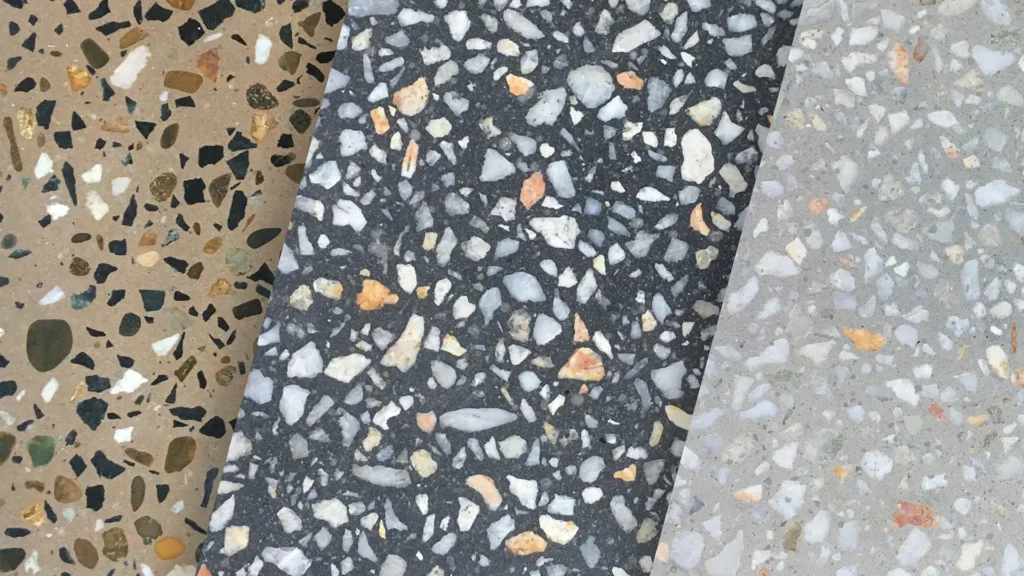
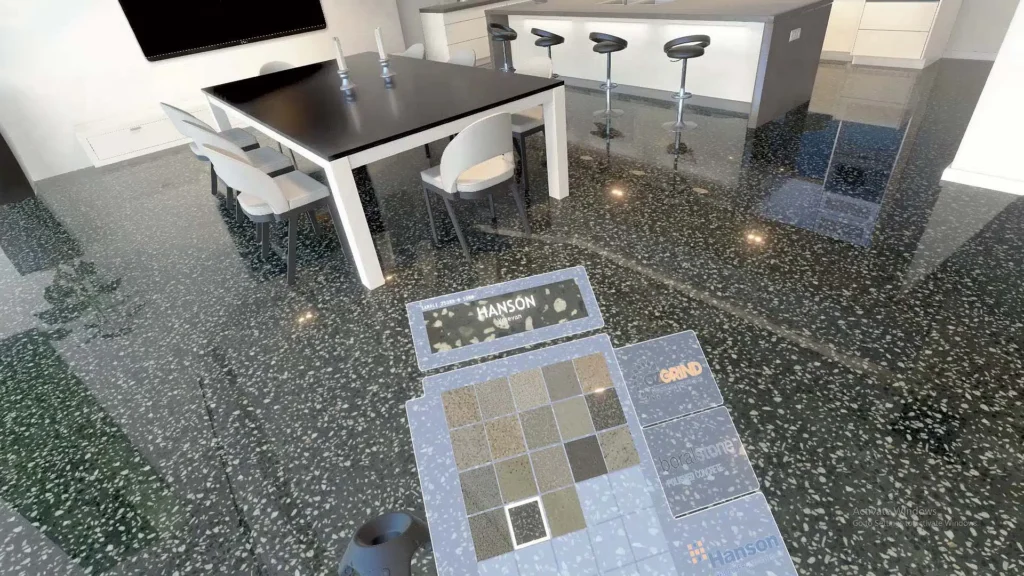
  • Three exposure levels: nil, minimal, and full stone.
  • Two key finishes: standard mechanical polish and honed.
  • True-to-life aggregate size: a 10 mm stone in reality is a 10 mm stone in VR.

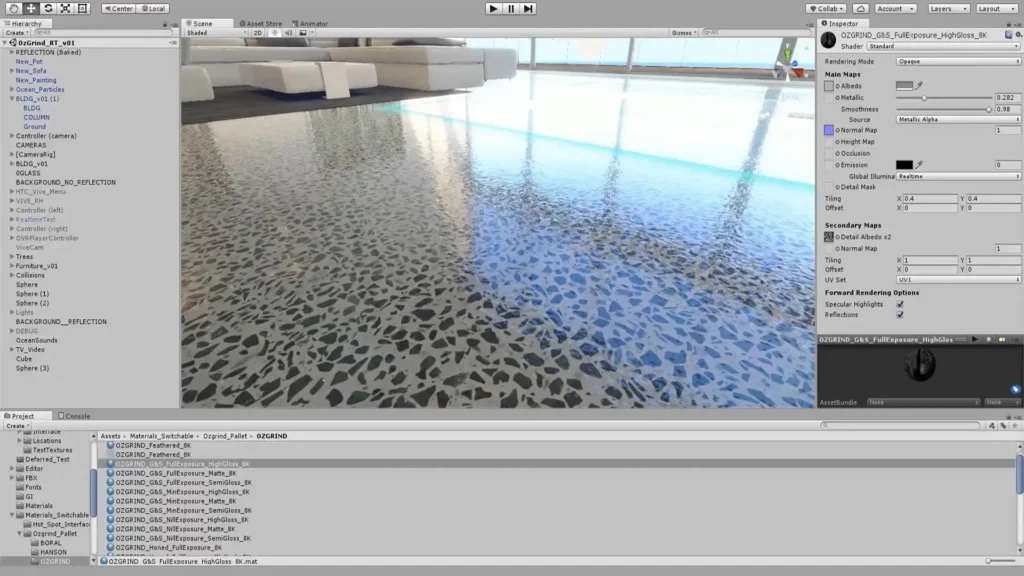
Procedural generation didn’t meet the standard for photorealism, so we scrapped it. Instead, we built a manual photographic capture pipeline. OzGrind received detailed capture guides and calibration tools, so that every reference image came in with reliable lighting and scale. Our technical artists then reconstructed each texture by hand for every exposure and finish combination, matching gloss, reflection, and stone distribution to the real samples.

2. An 8K material pipeline that set a new internal standard

To keep the experience usable in a sales context, we needed clients to be able to walk right up to the floor, inspect it closely, and not see pixelation or blurry patterns. We pushed every material to 8K resolution, combined with advanced antialiasing and custom supersampling inside the engine. This made text labels, floor transitions, and subtle finish differences read clearly through the headset lenses.​

Frankly, this pipeline forced Viewport XR to rethink how we handled material capture at scale. The work we did for OzGrind—digitising large numbers of real-world materials with photographic accuracy—became the exact foundation for the large-scale Kaboodle material capture pipeline in later years, turning this project into a proving ground for future deployments.

3. Agile build, in‑headset approvals

We ran a structured agile deployment framework with clear Kick Off, Pre Alpha, Alpha, Beta, and Launch stages. Each week, we jumped into scrums and live TeamViewer sessions with OzGrind, iterating on textures and finishes in real time as they compared the VR floor against their physical samples in the showroom.

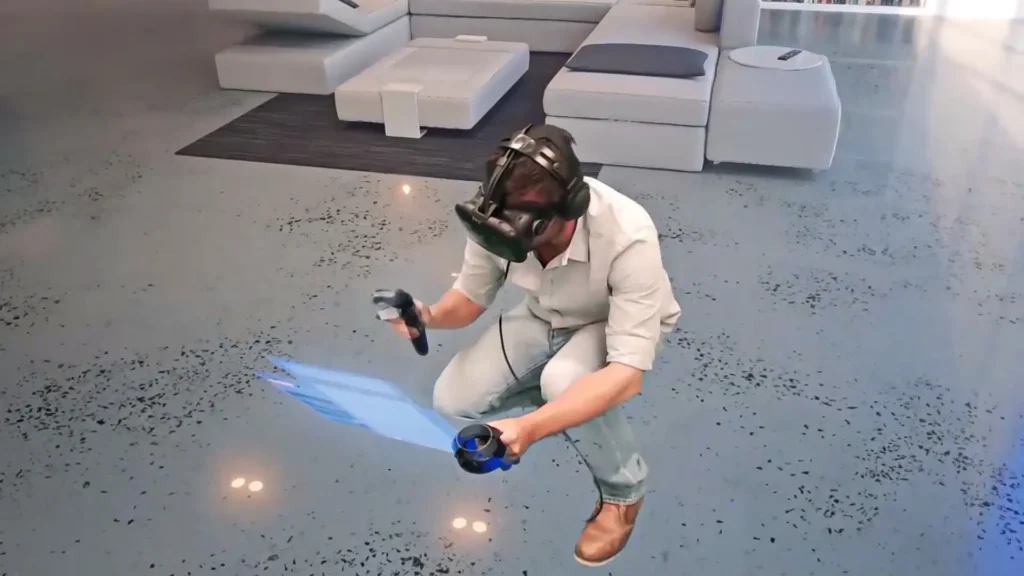
Instead of reviewing screenshots or PDFs, they could put on a headset, stand in a virtual room, and say, “The gloss level on this Valencia full exposure needs to be closer to this sample under our downlights.” That feedback loop kept the creative decisions tight and controlled rework and cost.

4. Hardware evolution: from tethered power to wireless sales floor

At launch, the showroom ran on custom PCs with GTX 1070 GPUs connected to HTC Vive and Vive Pro headsets. That horsepower was necessary to drive supersampling and 8K textures across large virtual floors without stutter.​​

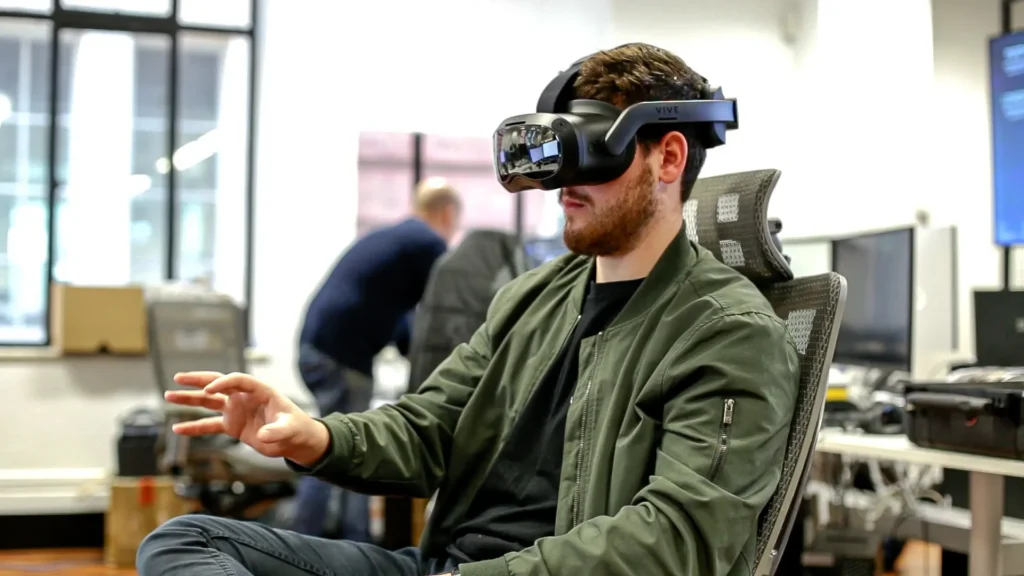
Some time later, as OzGrind’s physical showroom evolved, they came back with a new requirement: keep the visual fidelity, but remove the tether. We migrated the original application to run on Vive Focus 3 devices using Vive Business Streaming over a high-speed local network. This delivered the same visual punch as the original PC build—with no cables on the floor and no computers on show, just a clean, wireless showroom that sales staff could set up and run themselves.

Measurable Results

From Guesswork to a Repeatable “B2B Power Tool”

Before the VR showroom, a typical consult followed a familiar pattern. A client walked in, stared at racks of sample tiles, and tried to picture how a single piece would translate into an entire floor. The sales team repeated the same explanations about exposure levels, finishes, and light for each new project. Architects asked for more images. Owners delayed final selection. The decision process felt slow and uncertain.

After deployment, the way those meetings unfolded changed. Now a client could:

  • Put on a headset.
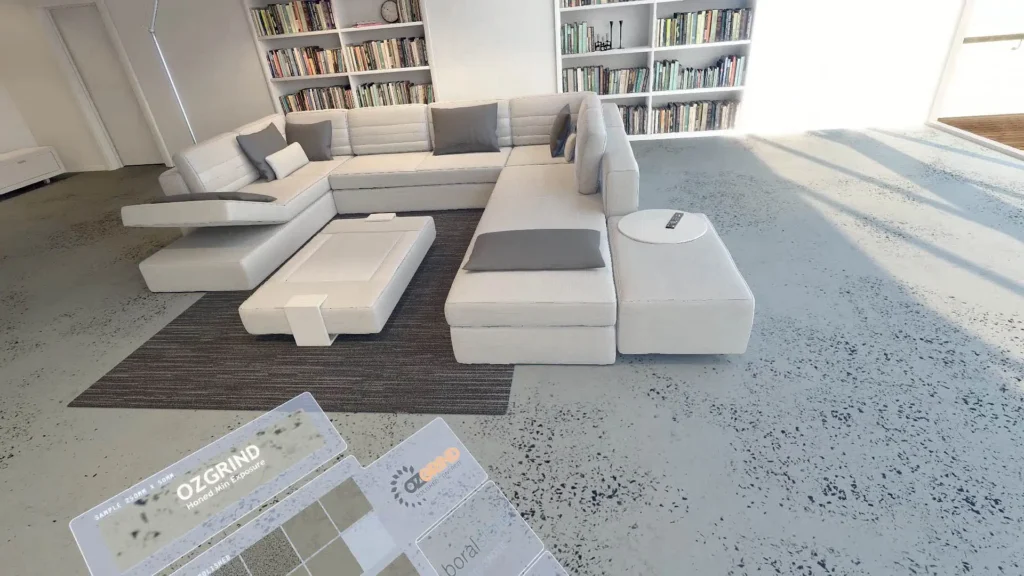
  • Walk across a full virtual floor in their chosen mix.
  • Switch exposure and finish on the spot.
  • See how the surface behaved under different lighting conditions.

The outcome wasn’t just that “they liked the VR.” It was that all the stakeholders started behaving differently. Hanson brought their entire Queensland account management team through the VR showroom to view their own products in context, turning what was once a static supplier relationship into an experiential session in OzGrind’s space. Top-tier architects began using the system as a decision engine, coming into the showroom not to browse vaguely, but to lock in specifications with confidence.

Internally, the tool changed how OzGrind’s team spent their time. Instead of walking clients through endless variations on the same conversation, the VR experience handles 80% of the “What will this look like?” questions in ten minutes, and they spend the rest of the meeting on scope, budget, and timelines. The sales team reports that clients arrive “warmer,” move faster through decisions, and leave the showroom with a clear mental picture of the final floor. OzGrind describes the software as a dominant B2B sales tool that directly supports their market-leading positioning.

Over the years, this wasn’t a one‑off experiment that faded. OzGrind ordered multiple expansion phases, adding more than twenty new materials into the system as their range grew. Each new batch slotted into the existing pipeline, giving them a living catalogue that could scale without rebuilding the entire experience. The VR showroom continues to anchor their pitch as “Australia’s most extensive polished concrete showroom,” backed by what they describe as the world’s first virtual polished concrete software to demonstrate every finish they offer.

From Viewport XR’s perspective, the OzGrind project now serves two roles:

For OzGrind, it is a practical, daily B2B power tool that helps them shorten decision cycles, keep architects loyal, and hold a clear leadership position in their market.

For Viewport XR, it remains a benchmark for digital material accuracy in XR. The project proved how a well-crafted VR showroom can move a complex, permanent purchase decision out of guesswork and into something clients can walk across before they spend a cent.​

If your clients struggle to picture the final result, a VR showroom can help them decide faster. Viewport XR builds B2B sales tools that turn samples, specs, and technical detail into something buyers can walk through.

Testimonials

X
Privacy Overview

This website uses cookies so that we can provide you with the best user experience possible. Cookie information is stored in your browser and performs functions such as recognising you when you return to our website and helping our team to understand which sections of the website you find most interesting and useful.