
Violence against healthcare workers had become too common to ignore. Western Health partnered with Viewport XR to build Reframe Your Response, a VR training simulator designed to help staff de-escalate aggression in the moment. The program is now deployed across Western Health’s 11,000-strong workforce, has contributed to a 44% reduction in work health and safety incidents, and helped reduce Additional Care Resources by 41 FTE (Full-Time-Equivalent) across two years.
How Western Health Used VR De-escalation Training to Improve Staff Safety at Scale
Client: Western Health
Sector: Healthcare
Workforce: 11,000 staff
Project Type: VR de-escalation soft skills training
Deployment Scope: soft skills training
Technology Used: Four acute public hospitals and community health centres

44%
reduction in work health and safety incidents

41 FTE
reduction in Additional Care Resources across 2023–24 and 2024–25

Award Winner
2025 National Safety Award for Excellence
The Challenge

Frontline healthcare workers operate in an environment where tension can turn fast. WorkSafe Victoria reports that up to 95% of healthcare workers have experienced verbal or physical assault on the job. At Western Health, that risk sat inside a large, complex public health network serving Melbourne’s fastest growing and most diverse region.

Western Health’s Occupational Violence and Aggression (OVA) team understood the stakes. Awareness was not enough. Staff already knew the principles of de-escalation on paper. The real gap appeared in the moment itself, when tone, posture, pacing, and self-control matter more than recall. That is where traditional training began to fall short.

De-escalation is not a checklist skill. It relies on emotional regulation, perspective-taking, and split-second judgment under pressure. Western Health needed a way to train those human skills without exposing staff to real risk, and without reducing a serious workplace issue to another policy module.
Why Old Methods Weren’t Enough
Written resources can explain a framework. They struggle to prepare someone for a live escalation. Lectures can define terms, but they cannot recreate the stress of a raised voice, a tightening posture, or the feeling that an interaction is slipping. Role-play helps to a point, but it rarely captures the unpredictability or emotional weight of a real event.
That created a stubborn training gap. Staff could learn the language of de-escalation, but that did not always mean they could apply it in the moment. Concepts like self-reflection, internal response management, and perspective-taking remained abstract when taught through slides, handouts, or staged exercises.
Western Health also needed staff to understand the patient’s point of view, not just the worker’s. In some cases, that meant recognising how hallucination or distress could reshape what a patient sees and hears. Frankly, that is not something traditional training handles well. If the learning never becomes visceral, it rarely changes behaviour.
The Solution
Viewport XR built Reframe Your Response, a hyper-realistic VR simulator designed to train de-escalation as an experience rather than a theory lesson. Instead of asking staff to imagine a difficult interaction, the training places them inside one. They stand in a hospital environment that feels familiar, face an escalating scenario, and see how their choices shift the outcome in real time.
The experience includes two modules:
- An agitated hospital visitor scenario
- A patient-perspective module that places the trainee in the perspective of a patient who is experiencing hallucinations

One module trained recognition, response, and emotional control in a live interaction. The other pushed perspective-taking beyond discussion and into direct experience. Trainees were not told in advance what the patient-perspective module would involve, and that lack of warning became part of why it worked. The shift caught people off guard. It made the lesson land.
Everything inside the simulator was built around credibility. Hospital layouts, sound design, pacing, dialogue, and character behaviour were all shaped to reflect the real-world Western Health staff work in. The goal was transfer: staff needed to leave the headset and carry what they had just learned into the ward.
How It Worked

Scenario design
Every scenario was shaped around the kinds of incidents Western Health staff actually face. That kept the training grounded. Dialogue sounded natural. Escalation patterns reflected real-world interactions. The rhythm of each encounter felt like a hospital, not a scripted demo.

Digital humans
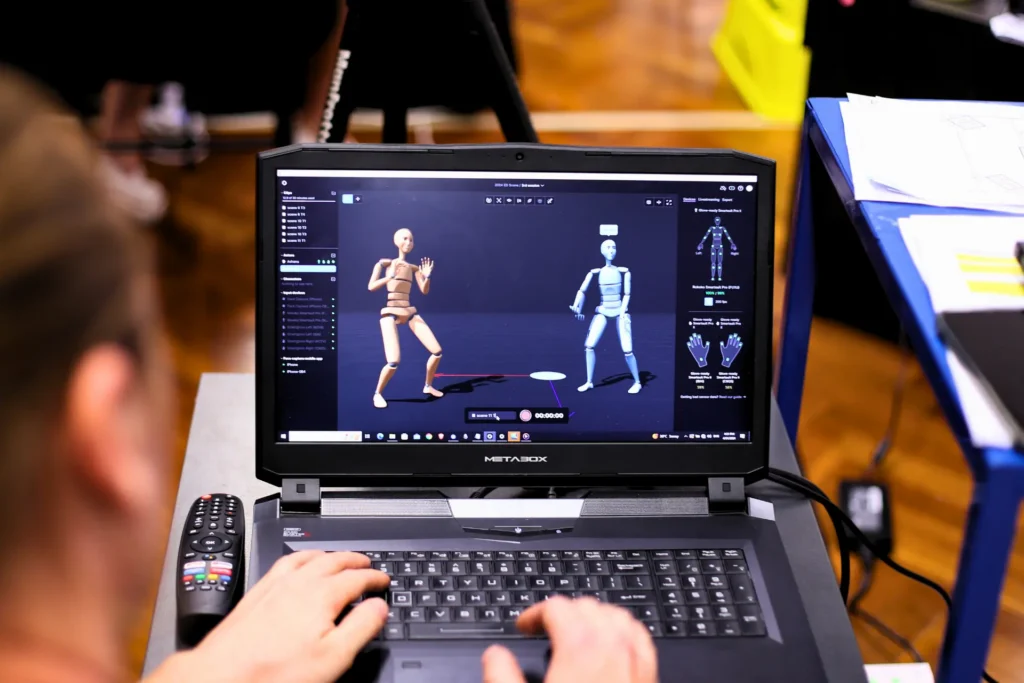
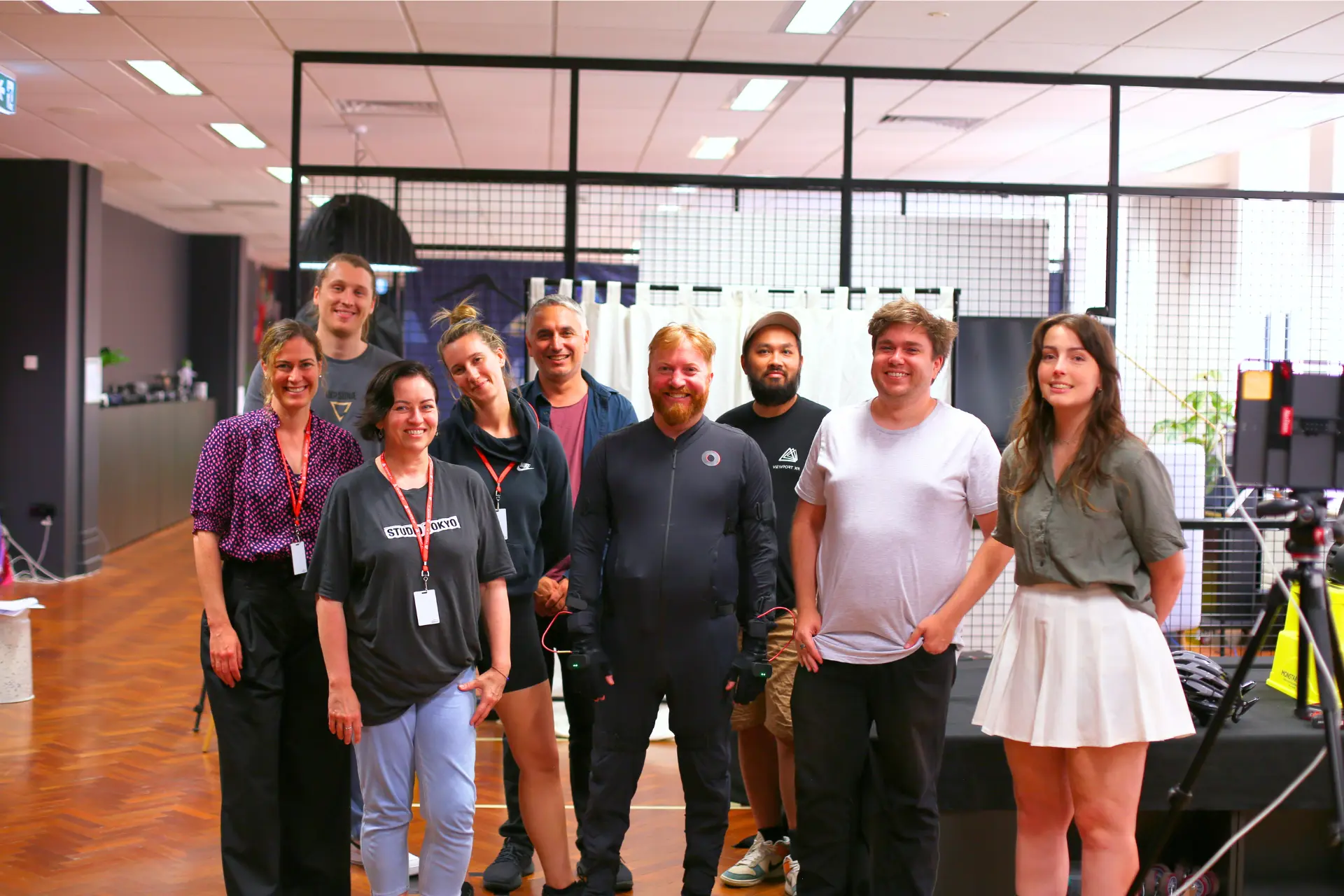
This project marked a major step forward in how Viewport XR approached believable human behaviour in VR. Using a heavily customised version of Epic Games’ MetaHuman, Rokoko performance capture, and Unreal Engine, the team built digital humans capable of showing micro-expressions, emotional shifts, and subtle changes in body language that matter in de-escalation.
Key features included:
- Custom 3D kitchen environments that matched common layouts and styles.
- Controls to change cabinet profiles, benchtop thickness, flooring, and hardware.
- Interactive elements so users could open doors and drawers with touch gestures.
- A clean UI that worked for both first-time users and repeat trade customers.
Performance capture
Performance quality was central to the result. The characters had to feel convincing enough that trainees would respond to them as people, not assets. In the agitated visitor scenario, the captured performances carried enough emotional weight that some trainees were moved to tears. That reaction said something important: the simulation was reaching people at the level where behaviour can change.
Branching dialogue system
Viewport XR layered a dynamic dialogue tree over the captured performances so the scenario could respond to trainee choices in real time. Small changes in tone or phrasing affected how the interaction unfolded. That allowed staff to see, inside the simulation, how reframing their response could shift the direction of a potentially dangerous encounter.
Collaboration with subject matter experts
This was a close build, not a handoff project. Western Health’s OVA team stayed embedded throughout the design, review and performance process, helping refine scenarios, validate behaviour, and ensure the training aligned with clinical reality. That collaboration helped keep the product accurate, useful, and trusted by the people who would deploy it.
Headset deployment
The initial rollout used VIVE Focus 3 headsets, chosen for lightweight delivery and the visual fidelity needed to support realistic character work. Hand-tracking replaced controllers, which reduced setup friction and let staff move straight into the training experience. Later, the project migrated to Meta Quest 3, retaining visual quality while improving compute headroom and fleet management via being directly installed onto the headset itself.
Deployment at Scale
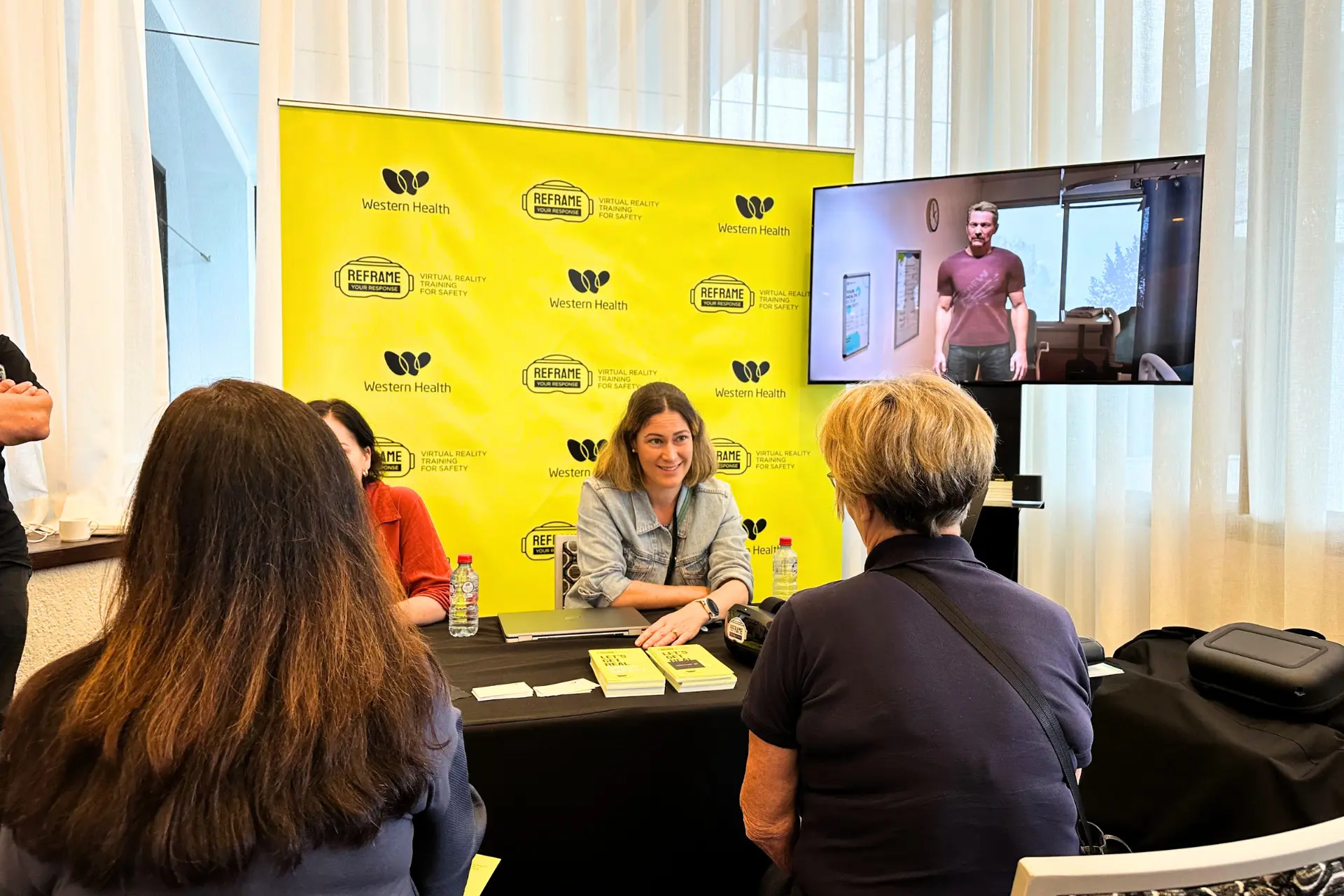
Western Health did not need a pilot that impressed a room and then be shelved. They needed a training system that could operate across a large workforce and fit into real hospital schedules. Viewport XR delivered the project through a structured agile framework with Kick Off, Pre Alpha, Alpha, Beta, and Launch milestones, supported by regular reviews with Western Health’s OVA team.
The deployment model was built for control as much as access. Headsets were locked into kiosk mode so staff entered the training directly, without getting lost in device menus or needing technical help before the session had even begun. Remote fleet management meant both Western Health and Viewport XR could manage updates, content access, and rollouts across the device base from a central point, even from across the country.
That mattered commercially and operationally. Training that once relied on facilitators, group sessions, and fixed blocks of time could now be booked in flexible slots and delivered where needed. When the experience later moved to Meta Quest 3, the team aimed to keep the full fidelity of the original build and used the added performance headroom to push character detail and environment quality even further.
Outcomes and Evidence
Before Reframe Your Response, Western Health relied on methods that often took days for staff to absorb and still struggled to make the harder parts of de-escalation stick. After deployment, the same ideas could be experienced directly, in context, and under pressure. That shift changed both the learning process and the operational result.
The strongest signal was the one leaders care about most: measurable impact. Western Health reported a 44% reduction in overall work health and safety incidents. Additional Care Resources, the one-to-one nursing and security cover required for high-risk patients, dropped by 26 FTE in 2023–24, a 33% decrease, followed by a further 15 FTE in 2024–25, a 21% decrease. Across the two years, that is 41 FTE returned to broader clinical capacity.
Those numbers matter because they describe more than efficiency. They describe time going back into care. Before the rollout, more staff hours were tied up in reactive cover for high-risk situations. After the rollout, that burden eased. Teams could redirect more attention to patients, managers could operate with greater confidence, and the training itself became easier to schedule because it no longer depended on full-day group delivery.
Western Health also saw value in how quickly the learning landed. Staff who once needed days to work through the OVA curriculum could now move through key parts of it in minutes, while absorbing concepts that had previously been hard to teach. Self-talk became visible. Perspective-taking became immediate. Emotional reframing stopped being an abstract idea and became something staff had felt in practice.
Awards and Credibility
The project has been recognised at both industry and academic level. In October 2025, Reframe Your Response won the NSCA Foundation / HSI Donesafe National Safety Award of Excellence in the category Best Solution for Managing Psychosocial Hazards at Work. It was also a finalist for Best WHS Training & Development at the 2025 Australian Workplace Health and Safety Awards.
The evidence base extends beyond awards. A formal assessment by Deakin University, led by Associate Professor Deb Kerr, found statistically significant improvements in trainees’ ability to identify early warning signs of aggression, apply verbal de-escalation techniques, and report confidence in managing potentially violent situations. Western Health secured a $50,000 grant to evaluate the education package across pre- and post-training intervals.
Elisa Ilarda, Western Health’s OVA Operations Manager, described the result as “an incredible outcome and more than we could ever have imagined.” That endorsement carries weight because it comes from the team closest to the problem, and closest to the operational change that followed.

See how VR training can help your frontline teams build confidence, reduce risk, and respond better under pressure.