Your VR training pilot went well. The nurses loved it as the engagement was high and people were talking about it long after the session ended. Some even called it the best training they’ve done in years.But sooner or later, someone is going to ask the question that really matters:
Was It Worth the Investment?

And that’s where a lot of healthcare organisations get stuck.
Not because the training didn’t work. Not because the staff didn’t learn anything. But because nobody decided upfront how success would be measured.
If you’re trying to prove VR healthcare training ROI, counting completions or collecting positive feedback won’t be enough. Executives, finance teams, and decision-makers want to see evidence that the training delivered tangible results. Did staff reach competency faster? Did they retain knowledge longer? Did performance improve in real clinical situations? Did the organisation save time, resources, or training costs?
The good news is that measuring ROI doesn’t have to be complicated. And it certainly doesn’t require finding some universal percentage that applies to every healthcare organisation.
Instead, it starts with a much simpler question:
What are You Trying to Improve, and How will You Measure Whether VR Helped Improve It?
Once you have a clear answer to that, building a strong business case becomes much easier.
In this article, we’ll walk through the metrics that matter most, how healthcare organisations can measure the impact of immersive training, and what it takes to demonstrate real value beyond the excitement of the technology itself.
Why ROI is a Harder Question in Australian Healthcare
Australian health services run on thin margins and thinner rosters, so every training dollar competes directly with clinical hours. That pressure is only increasing. Department of Health modelling projects a national undersupply of 70,707 full-time equivalent nurses by 2035, with acute care facing the biggest gap at 26,665, followed by primary healthcare at 21,765 and aged care at 17,551.
That shortage changes the maths on training. When you pull eight nurses off the floor for a full-day session, you are not just spending on a trainer and a room, you are spending on backfill, agency cover and overtime in a market where those people are genuinely hard to find. So, the value of virtual reality healthcare training in Australia is not just that people learn better. It is that they learn faster, on shift, without a room booking, which returns clinical hours to a system that has none to spare.
What does ROI Mean in Healthcare VR Training?
The traditional ROI formula is straightforward:
ROI = (Financial benefits − Investment) ÷ Investment × 100
It works well when the benefits can be directly expressed in dollars.
Healthcare training is different.
The value of virtual reality healthcare training can appear across several areas:
- Training costs
- Staff time
- Time to competency
- Knowledge retention
- Practical skills
- Safety
- Workforce capacity
- Training scalability
- Patient-related outcomes

Some of these outcomes can be directly converted into financial value. Others are better treated as operational or educational measures.
This distinction is important because healthcare simulation research still does not consistently measure ROI in the same way. A recent review of healthcare simulation studies found that financial and cost-related outcomes are measured more often than broader organisational returns.
That means there is an opportunity for healthcare organisations to do something different: build measurement into the training program from the beginning.
The strongest approach connects:
Training → learning → behaviour → operational outcome → business value
7 Metrics to Measure VR Healthcare Training ROI
1. Cost Per Learner
Start with what your organisation is already spending.
The cost of traditional training can include much more than the trainer’s salary or the price of a classroom.
Consider:
- Trainer hours
- Classroom or simulation facilities
- Travel
- Accommodation
- Equipment
- Administration
- Staff time away from clinical duties
- Repeat training
- Training materials
Then calculate the full cost of VR training, including content development, hardware, software, implementation, maintenance and support.
The important comparison is not:
Is a VR headset cheaper than a classroom?
It is:
What does it cost to train this workforce using our current approach, and what would it cost to deliver the same training through VR at the required scale?
That gives decision-makers a much more realistic baseline.
2. Time to competency
How long does it take someone to become competent?
This is particularly relevant for healthcare organisations onboarding new employees or training staff across multiple locations.
Measure the time from the beginning of training to a defined competency standard, then compare the result with your existing approach.
Research into VR in healthcare education is encouraging. A 2024 systematic review and meta-analysis of 45 studies found that VR improved knowledge and skill scores, reduced skill performance time and improved learner confidence and satisfaction.
More recent research also suggests that immersive VR can support clinical skills training, although the strength of evidence varies and long-term retention is still an area that requires further study.
The takeaway is simple:
Do not assume VR makes people competent faster. Measure it.
If time to competency falls without lowering the assessment standard, you have a meaningful outcome to take into your ROI calculation.
3. Knowledge Retention
Passing a test immediately after training tells you something.
But it doesn’t tell you the whole story.
To understand whether learning actually works, healthcare organisations need to measure knowledge at multiple points:
Before training → immediately after → 30 days → 60 or 90 days
Tracking performance over time reveals whether employees retain what they’ve learned or whether they need additional reinforcement.
Consider a healthcare organisation using VR to train staff on emergency procedures. Instead of measuring completion rates alone, it could compare assessment results before and after training, then run the same assessment again several months later. That approach provides a much clearer picture of how well the training is working.
The result is a far more meaningful measure of learning than a satisfaction survey or a one-off test score because the goal of training isn’t to create an enjoyable VR experience.
The goal is to help people remember what they’ve learned and apply it confidently when it matters most.

4. Changes in Skills and Behaviour
This is where VR can become particularly useful.
Instead of asking:
Did the employee complete the training?
ask:
Can they perform differently because of it?
Depending on the training objective, organisations could measure:
- Procedure accuracy
- Decision-making
- Response time
- Hazard identification
- Communication
- De-escalation behaviour
- Protocol adherence
- Number and severity of errors
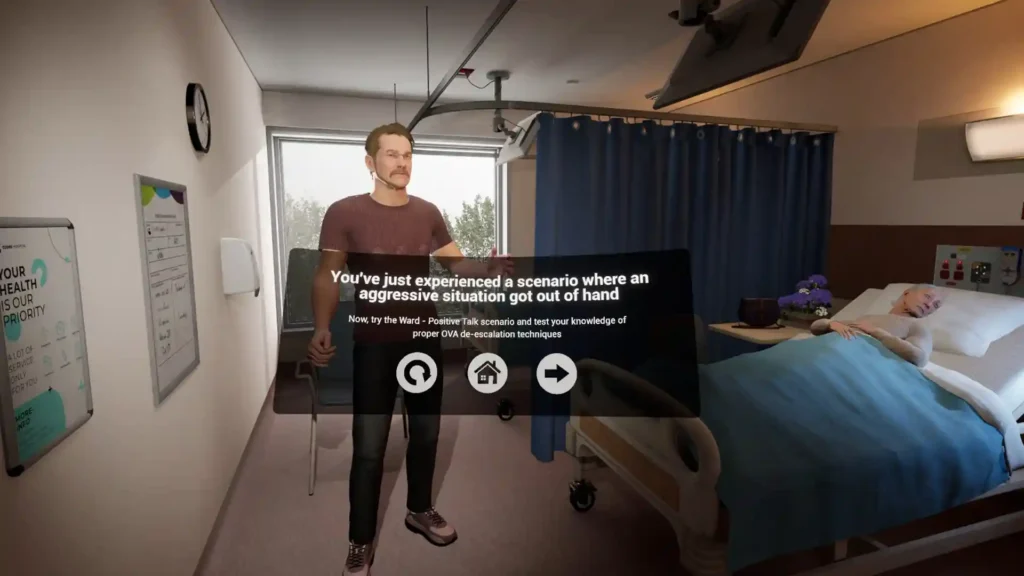
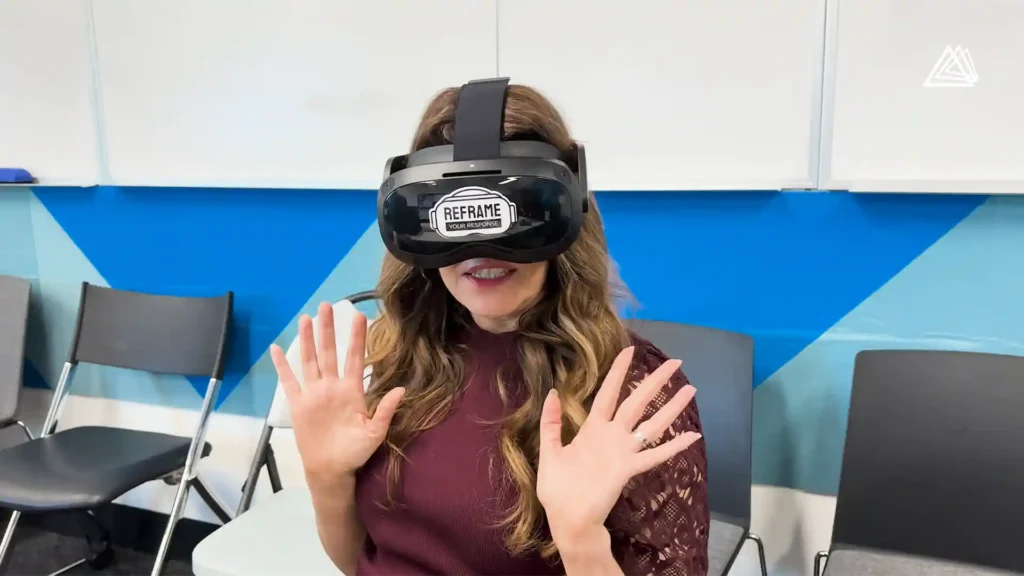
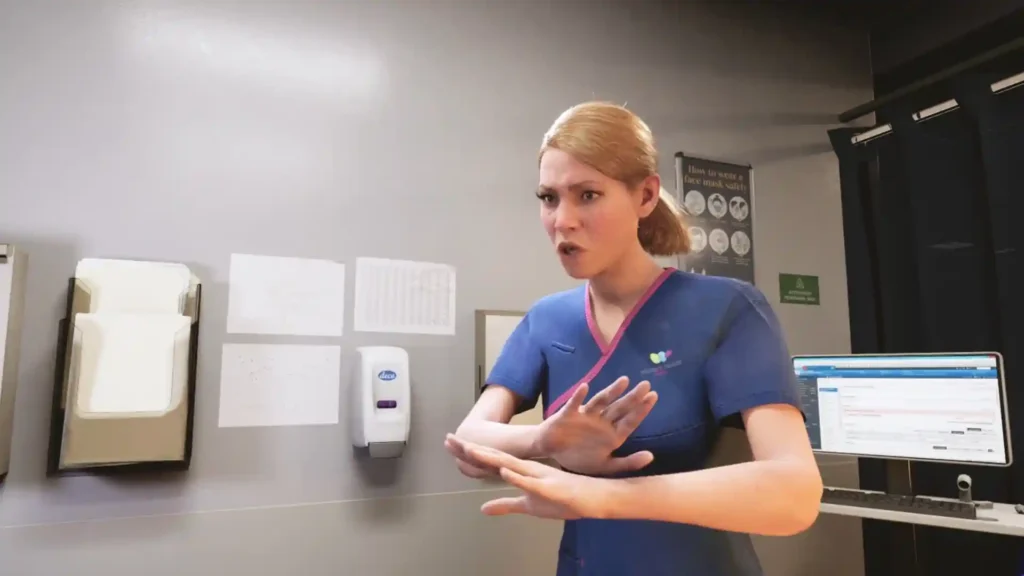
Imagine a healthcare worker practising an occupational violence scenario.
A traditional course might explain what the worker should do.
A VR scenario can put the worker inside a realistic situation and allow them to practise how they respond.
That creates the opportunity to measure behaviour, not just knowledge.
Viewport XR’s VR Healthcare Training solutions include applications such as empathy training, occupational violence de-escalation and anatomy education, where the ability to practise realistic situations can be particularly relevant.
The objective is not immersion for its own sake.
The objective is better performance when it matters.
5. Safety and Incident Outcomes
For some healthcare training programs, safety may be the most important metric of all.
If the training is designed to improve de-escalation, emergency response, infection prevention or other safety-related behaviour, organisations can establish a baseline and monitor relevant outcomes over time.
These could include:
- Workplace incidents
- Near misses
- Safety breaches
- Escalations
- Injuries
- Use of additional resources
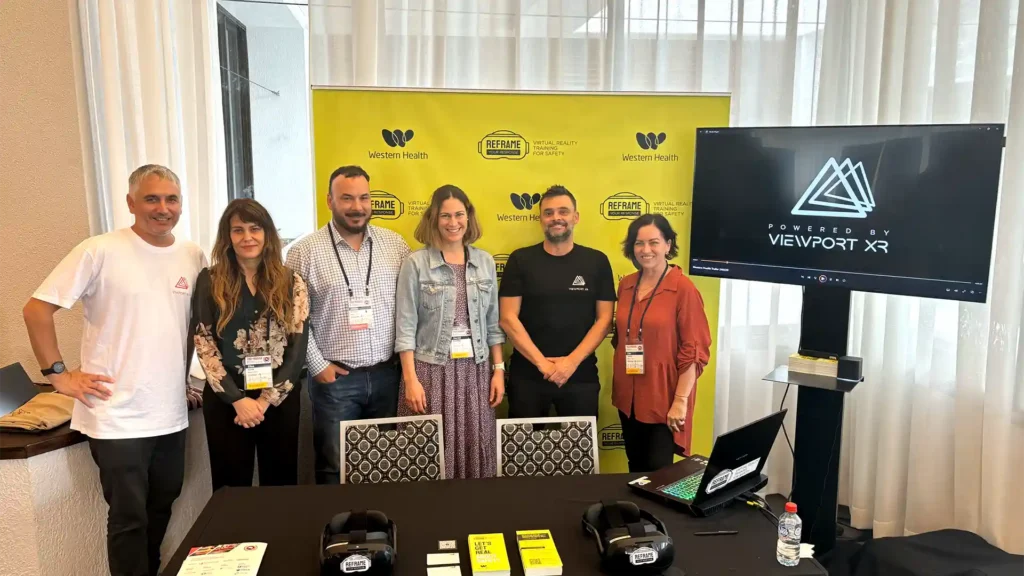
There is a strong Australian example in Viewport XR’s work with Western Health.
One strong Australian example comes from our work with Western Health.
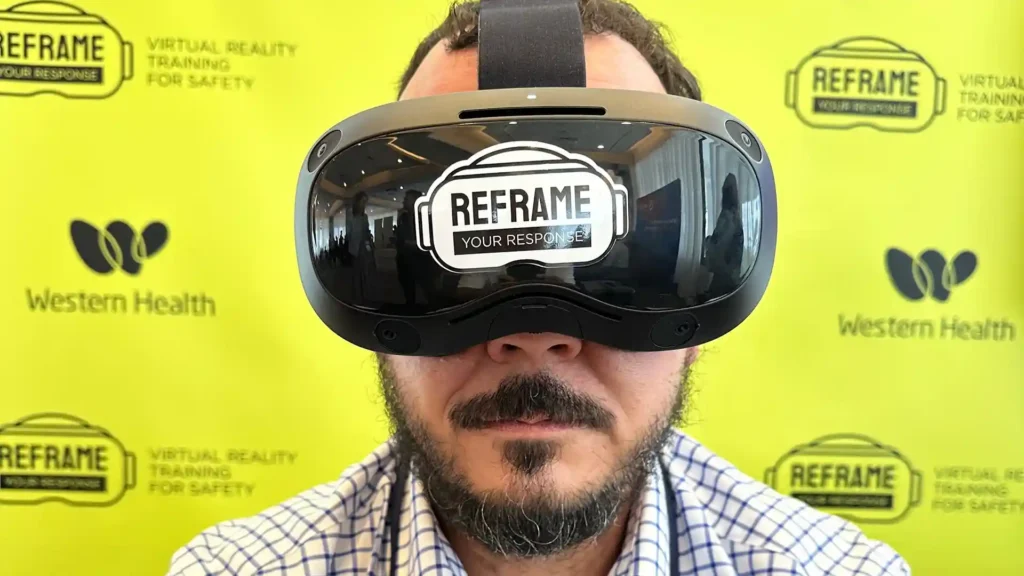
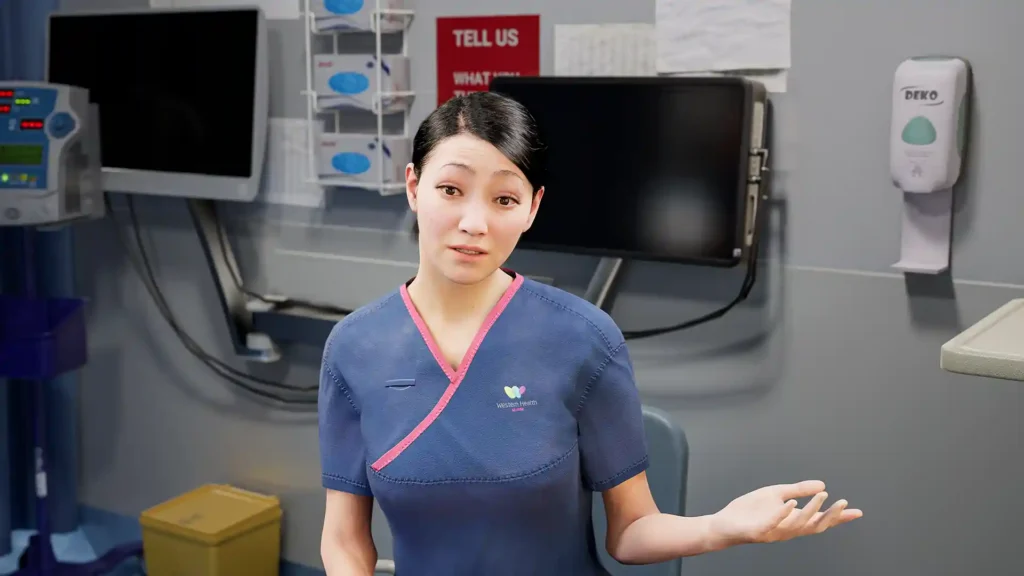
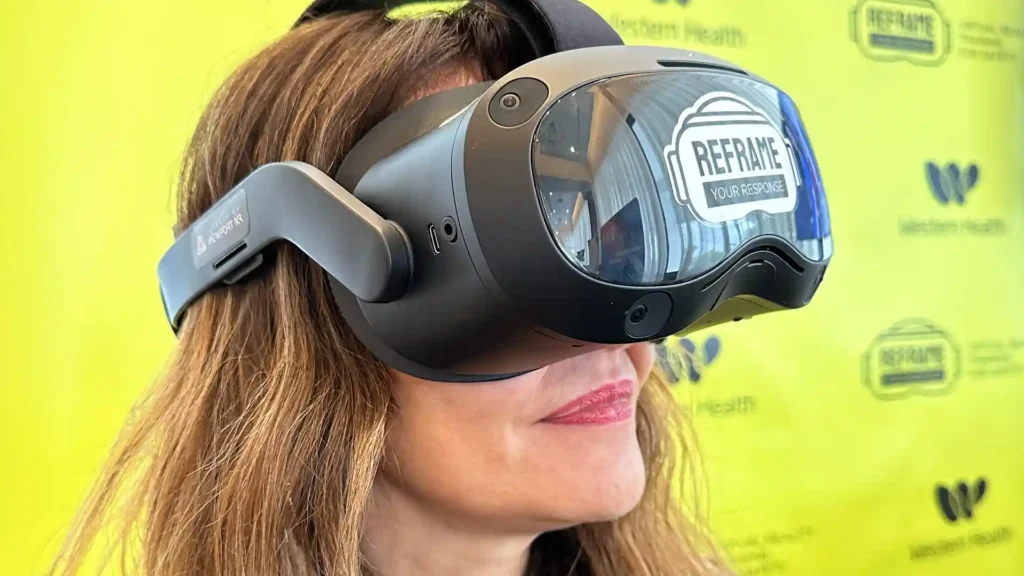
We developed Reframe Your Response, a VR occupational violence de-escalation training program and deployed it across a workforce of approximately 11,000 people. Following implementation, Western Health reported a 44% reduction in work health and safety incidents and a 41 FTE reduction in Additional Care Resources across 2023-24 and 2024-25.
These outcomes are significant because they connect training to real operational results.
However, it’s important to view them in the right context. These are reported outcomes from a specific implementation, not a guarantee that every healthcare organisation will achieve the same results.
That’s why ROI measurement should focus on a single question: What changed in our organisation after the intervention compared with our baseline?
6. Operational Efficiency
Some of the returns from VR may not appear as a line item called “money saved”.
It may appear as capacity.
Ask:
- How many employees can be trained each month?
- How many trainer hours are required?
- How much travel can be avoided?
- How much classroom space is required?
- How quickly can employees repeat a scenario?
- Can the same training be delivered consistently across multiple sites?
- How much administration is involved?
This can be particularly relevant for Australian healthcare organisations with geographically dispersed workforces.
For regional and remote healthcare providers, travel alone can add significant complexity to training delivery.
A 2026 review of simulation-based education in rural and remote healthcare found increasing use of technology-enabled approaches to support education across geographically dispersed settings, while also highlighting gaps in evidence around broader workforce and system outcomes.
That means scalability should not simply be described as a benefit. Measure it.
7. Workforce and Patient-related Outcomes
This is where healthcare organisations should be cautious.
VR may potentially contribute to:
- Staff confidence
- Preparedness
- Communication
- Clinical performance
- Reduced errors
- Patient experience
But potential is not the same as proven causation.
Current research is stronger around learner outcomes such as knowledge, skills and confidence than it is around direct patient outcomes.
For example, recent research examining whether VR infection prevention training translates into real-world clinical practice found that the impact on actual practice remains unclear.
So rather than claiming:
VR improves patient outcomes,
a more credible approach is:
We will measure whether the training is associated with changes in the patient or clinical outcome we care about.
That difference may sound small, but it makes the business case much more defensible.
How to Calculate Your Own VR Healthcare Training ROI
The maths behind ROI is simple. The difficult part is identifying which costs and benefits can be measured reliably.
Healthcare simulation research has used approaches such as cost-benefit analysis, cost-effectiveness analysis and ROI to assess whether simulation delivers enough value to justify its investment. However, researchers have also highlighted differences in how simulation costs and outcomes are measured, which makes it difficult to apply one universal ROI figure across different programs.
For a VR training program, a basic ROI calculation is:
VR Training ROI = (Financial benefits − Total VR training costs) ÷ Total VR training costs × 100
The important part is what you put into those two numbers.
Step 1: Calculate the full cost
The cost of VR training should not be limited to the price of headsets.
Depending on the program, include:
- VR content development or customisation
- Hardware
- Software and licences
- Implementation
- Maintenance and technical support
- Trainer and administrator time
- Staff time spent completing training
- Facilities and other delivery costs
You can then compare this with the equivalent costs of your existing training approach.
Step 2: Identify Measurable Financial Benefits
The potential financial benefits will depend on what the VR program is designed to change.
For example:
- Fewer trainer hours
- Reduced travel and accommodation
- Less classroom or simulation-facility use
- Reduced staff time away from clinical duties
- Faster time to competency
- Fewer repeat training sessions
- Reduced operational costs associated with specific training-related incidentsNot every benefit will apply to every program. The goal is to measure the benefits that are relevant to your original training problem.

Step 3: Keep Educational and Operational Outcomes Separate
This is where ROI calculations can easily become misleading.
Suppose a VR program increases learner confidence or engagement. Those are useful outcomes, but you should not automatically assign them a dollar value.
Instead, report them separately alongside the financial calculation.
For example:
Financial outcome: $50,000 in measurable training and travel savings.
Educational outcome: Improved assessment scores and knowledge retention.
Operational outcome: Reduced time required to reach competency.
This gives decision-makers a fuller picture without turning every positive result into an invented financial benefit.
The approach is consistent with healthcare simulation research, which recommends looking at both financial and non-financial value when assessing simulation programs.
A simple example
Imagine a healthcare organisation spends $120,000 implementing a VR training program.
After establishing a baseline and tracking the program, it identifies $168,000 in measurable financial benefits from reduced delivery costs, staff time and travel.
The calculation would be:
($168,000 − $120,000) ÷ $120,000 × 100 = 40% ROI
The organisation could then report a 40% financial ROI, alongside other outcomes such as learning performance, confidence, competency time or safety measures.
That is a much more defensible business case than saying VR delivers a particular percentage return in every healthcare setting.
The key is to measure your own baseline, define the outcomes before implementation and only monetise benefits that you can reasonably support with data.
Four Ways People Get This Wrong
Measuring the Wrong Things
Headset usage, completion rates, and positive feedback can tell you whether people engaged with the training. They don’t tell you whether the training delivered a return.
Rolling the Program Out to Everyone at Once
Keep a comparison group wherever possible. It costs nothing, and it gives you a clear way to measure whether the training actually drove the outcomes you’re seeing.
Evaluating Results Too Early
Real behaviour change takes time. Instead of reviewing performance a few days after training, check in at 30, 90, and 180 days to see whether new skills are being applied consistently.
Overlooking Operational Costs
ROI calculations should include more than the training itself. Device management, charging, cleaning, content updates, and ongoing administration all contribute to the true cost of the program.
Don’t Start with the Headset. Start with the Outcome.
If your healthcare organisation is considering immersive training, Viewport XR can help you identify where VR can create measurable value, from clinical education and empathy training to occupational violence de-escalation and workforce development.
Explore Viewport XR’s VR Healthcare Training solutions or read our Dementia Training Australia case study to see how Australian organisations are using immersive learning to improve knowledge retention, engagement, and real-world performance.